Reduce Identity‑Led Cyber Risk Where It Matters Most
We help organisations disrupt real identity attack paths —
not just improve IAM posture on paper.
This service takes strategic intent and examines where real attackers would bypass it.
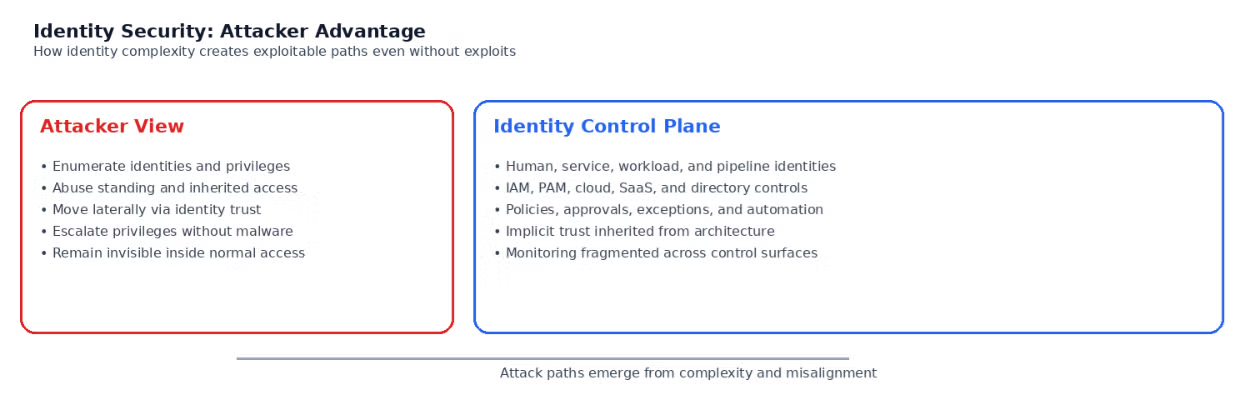
Most modern cyber attacks do not “hack” systems — they abuse identity. Privileged access, weak authentication, excessive entitlements, and poor visibility allow attackers to move undetected and escalate impact.
Arcalis Services helps organisations materially reduce identity‑led cyber risk by focusing on how attacks actually unfold, not on theoretical controls or tool‑driven checklists.

The Problem
Identity Is the Primary Attack Path — and Classic Controls Rarely Stop It
Organisations invest heavily in perimeter security, detection tooling, and compliance frameworks,
yet still struggle to contain identity‑driven risk.
Common symptoms include:
- Excessive or standing privileged access across users, workloads, and service accounts
- Inconsistent authentication and access controls across cloud, on‑prem, and SaaS platforms
- Limited visibility into how identities could be abused during a real attack
- Controls designed for audit success rather than adversary behaviour
When identity risk is misunderstood or misprioritised, attackers gain:
- Stealthy lateral movement
- Privilege escalation without noise
- Durable persistence inside trusted systems
The result is not just technical exposure, but business risk at board level.
The Outcome
Measurable Reduction in Identity‑Driven Risk
This service is focused on outcomes, not activity.
Clients gain:
- A clear understanding of their most likely and most dangerous identity attack paths
- Reduced standing privilege and fewer high‑impact compromise scenarios
- Identity controls aligned to real adversary behaviour, not generic “best practice”
- Greater confidence that identity will not be the weakest link during an incident
The objective is straightforward: make identity a hostile environment for attackers, without paralysing the business.
No control environment is perfect — the objective is to reduce likelihood, limit blast radius, and shorten time to detection.
What We Do
Practical, Threat‑Informed Identity Security
We assess and reduce identity risk by examining how your organisation would be attacked in reality — not how it looks on paper.
This service focuses on reducing identity‑based attack paths, not on providing operational security monitoring or incident response.
Typical activities include:
- Identity threat modelling focused on real‑world attack techniques
- Analysis of privilege pathways across human and non‑human identities
- Review and rationalisation of privileged access models
- Identification and reduction of standing privilege
- Alignment of authentication, access, and monitoring controls to risk
Where appropriate, this work incorporates:
- Privileged Access Management (PAM)
- Identity Governance and lifecycle controls
- Cloud and hybrid identity security considerations
The emphasis is always on risk reduction, not tool deployment for its own sake.
We advise, challenge, prioritise, and shape — we do not sell tools or deliver vendor‑led implementations.
How We Engage
Senior‑Led, Vendor‑Independent, Focused
Engagements are intentionally small, senior‑led, and independent.
Depending on your needs, we provide:
- Targeted risk assessment and advisory
- Design and prioritisation of identity security improvements
- Oversight and challenge of existing IAM or PAM initiatives
- Support during or after security incidents where identity is suspected to be a factor
You will work directly with senior practitioners who have dealt with identity risk under real attack conditions, not delegated delivery teams.
Who This Is For
Designed for Organisations Where Identity Exposure Has Consequences
This service is well‑suited to organisations that:
- Operate in regulated or high‑impact sectors
- Are cloud‑first or hybrid, with complex identity estates
- Have experienced security incidents or credible near‑misses
- Need to explain identity risk clearly to senior leadership or the board
It is particularly relevant for:
- CISOs and Heads of Security
- CIOs responsible for enterprise risk
- Risk and resilience leaders
Why Arcalis for Identity Risk
Real‑World Judgement When It Matters Most
Arcalis Services brings a rare combination of:
- Deep IAM expertise
- Experience responding to advanced, identity‑centric attacks
- Independence from vendors and implementation incentives
- The ability to explain complex identity risk in terms senior leaders understand
This allows us to focus on what genuinely reduces risk — not what is fashionable, over‑engineered, or commercially convenient.
Start a Conversation
Reducing identity‑led cyber risk starts with understanding where you are most exposed.
If you would like to discuss how identity risk affects your organisation — or whether this service is appropriate for your situation — we welcome an initial, no‑obligation conversation.
This work is most valuable before an incident forces the issue.